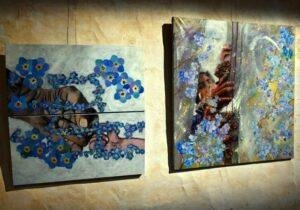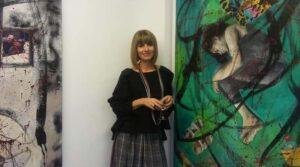

Christina Foitou is an expressionist painter whose core proposition lies in representing the physical traces of a moving female model, directly challenging the historical canon of the stationary figure.
01. Overturning Historical Conventions
The static model has held a prominent place throughout art history, serving as a symbol of nature and the personification of ideal beauty. Traditionally, rendering the motionless figure enabled artists to freeze time and glorify beauty in eternity through a single captured moment. While relentless time deconstructs all things, art historically sought to preserve the memory of youth, beauty, and happiness.
Foitou completely overturns these longstanding conventions. By placing her model in continuous motion according to specific guidelines—while maintaining space for spontaneous response—she shifts the focus entirely. Her images trace movement in real time, reverently collecting a complex web of motion traces across the canvas surface and distorting traditional representation in a manner reminiscent of Futurism's temporal analysis.
"The artist focuses not on the isolated moment, but on duration—recording a physical activity that is not a metaphor for eternity, but a tracing of expressiveness through time."
02. Duration, Interaction & Methodology
Foitou focuses on duration rather than instantaneity. Her work records an expressive daily dance activity in all its complexity. Unlike Yves Klein’s Anthropometries, where the artist maintains distance while models leave impressions, Foitou takes a direct and active role. She interacts dynamically with the model on an expressive level, actively tracing movement onto paper as it unfolds.
The primary stake is no longer idealized beauty, as the resulting work transcends literal representation. It becomes a procedural archiving of physical activity in time, where the female form transitions into a rhythmic sequence of physical curves imprinted upon the surface.
"Can these physical records acquire the significance that art once bestowed upon the frozen image of ideal beauty?"
03. Fundamental Questions
Foitou's practice poses essential questions to contemporary painting: Can these physical records acquire the importance that art once gave to the immovable, frozen image of ideal beauty? Can the body's contours and raw presence evoke the same depth of character and soul that traditional portraiture once sought to convey?
These fundamental inquiries direct Foitou’s work—questions that are as critical to the evolution of contemporary art as they are complex to answer with finality.