
“I don’t want my art to be at a distance from life. I want my works to be one thing with life. To have a constant dialogue, where you take and give. This perfect, immortal, idealized beauty does not concern me as an artist. I want the work to be alive. To talk to you, and talk to everyone.”
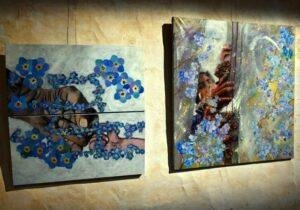
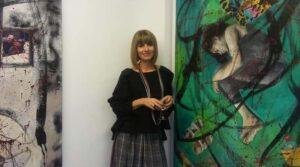
With her first solo exhibition “Room 526”—presented as part of the XANI Agency program at the B. Mylonogianni Art Gallery—Christina Foitou introduced the Chania public to surprising, movement-bound works. Painted on paper, her creations seek to capture bodies in motion, gestures, and dance figures, bearing the material footprints of those present during creation alongside the artist’s pigments. Unclaiming immortality, Foitou’s paintings praise everyday life in its infinite, evolving versions.
Why do you characterize your works as time-honored or time-bound paintings?
It is not done consciously, but judging by the result, one sees an attempt to hold movement in time—even if that is completely contradictory, since movement is inherently elusive. This effort is central to my inquiry, though not an end in itself. I always hope that anyone looking at the work will perceive or feel, even momentarily, the movement that existed when the piece was born.
What weighs most on you as a creator: beauty or emotion?
In contemporary art, idealized beauty is not the point. Other questions trouble and concern me. However, when the work meets its audience, a slight tension around beauty can arise—wondering if something might appear visually jarring. For example, in works I created for the Biennale, fabric was attached with paper tape and frayed over time. I initially wondered if this would disrupt the viewer's eye. But essentially, that doesn't concern me, because that fraying is the life of the project. Ultimately, the emotion a work triggers carries far more weight.
"I never thought my works would stay forever through time. I leave them open to the behavior of the world. Open to life."
Love and birth are ways to deal with decay and death. Is art another way?
In my practice, that is not the case. I never intended my works to remain unchanged forever through time. It doesn't bother me that things decay; I treat my art with that same acceptance. I leave the works open to the behavior of the world and to life. Just as a person carries scratches or imprints over time, so do these works.
This is an unconventional stance, given that art often seeks distance from everyday life...
I don't want that distance. I want my works to be one with life—a constant give-and-take dialogue. The perfect, immortal, or idealized does not concern me as an artist. I want the work to be alive, conversing directly with whoever stands before it.
A hymn to everyday life?
Everyday life can be hard and demanding, but it truly deserves a hymn.
Do you believe in inspiration?
I believe in a mental state rather than abstract inspiration. A particular state of mind generates anxieties and questions that I later sit down to investigate through work. I am deeply inspired by dancers. Any female body possesses the ability to dance, and that always moves me. I am fortunate to collaborate with my friend and muse, Natalia Partheniou, who has performed in all official presentations, allowing us to develop the works together whenever inspiration demands.
"A project will end when it goes to a home and I no longer have the right to intervene."
How many interpretations can an artwork endure?
Endless—as many as the thoughts, feelings, and temperaments of its viewers. I often learn things about my work from spectators. During this exhibition, someone noted that a piece felt like a 'punch to the establishment' politically. That impressed me, as it wasn't my conscious thought, yet the work opened space for that reading.
With your background in Pedagogy, do you think viewers must be initiated in art history to enjoy a work?
When art is non-representational, a little familiarity helps the viewer feel the artist's pulse. But that does not exclude non-initiates. During this show, visitors told me: 'I know nothing about art, but I am captivated by your colors' or 'I cannot take my eyes off this form.' That is deeply touching. They felt something real without needing formal theory.
Is an exhibition the final destination of a project?
No, of course not. It's merely a refueling break in a port. The work is on display in order to keep traveling further.
When do you feel a work is complete?
Never. Even after works left the studio, I was adding touches in the gallery. I believe a project is only finished when it enters someone's home and I no longer have the right to intervene. If works return to my studio, I cannot guarantee they will stay as they are.
How do you view the cultural scene in Chania?
Despite spatial and logistical challenges, there is impressive cultural vitality, especially in the visual arts. Five years after moving to Chania as an outsider, I was amazed by how much space, acceptance, and encouragement I was given to flourish artistically. It speaks volumes about the community's openness to new ideas.