
EXHIBITION ARCHIVE — SOLO SHOW FRAGMENTS ITINÉRANTS Christina Foitou DATES...
Read MoreText by curator Louisa Karapidaki on the exhibition entitled From body to body
- February 20, 2018
Christina Foitou, focusing on the psyche of the woman, transfers to the canvas the entire female emotional world. With her intense expressionist writing she sketches emotions, sorrows and pains, anxieties and expectations, joys and pleasures, thus composing the temperament and experiences of the modern woman.
She illustrates with eloquence female adverse emotional experiences and is sometimes expressed with tenderness and sometimes with cynicism, sometimes vivid and sometimes suggestive. Its artistic physiognomy is now recognizable and is characterized by fragmentary images that turn into solid narratives with flow in a fascinating gesture. Her works with obvious intensity, pictorial exuberance and synthetic complexity appear as fleeting on the move images full of energy and sometimes explosiveness. The morphic plasticity of the painting surface refers to snapshots of performances, that is, it gives the impression that it is part of a staged experiential performance, which continues in perpetuity. This is essentially a justified aesthetic loan, since the artist is also active in this art form and the action with intense mobility affects her plastic idiom.
Focusing on traumatic stories, Photou makes references to concepts such as social exclusion, isolation, coercion, humiliation, abuse, oppression, etc. and her works echo a clear protest against the problems faced, visibly or obscenely, by women of modern times. In her illustrations she embeds according to conceptual references and emblematic images, such as the ankantha ribbon for pain, the burqa for containment and isolation, the mask for silencing to abuse even insects, as unsuspecting intruders-saraks to denote constant attrition from permanent intimidation, violence and oppression. She even carries other concepts in her painting, purely personal female psyche, this time around motherhood. It illustrates mixed emotions, worries, joys, losses, guilt, emotional gaps, difficult goodbyes, as he notes in the project “Wishnesses”: “Where is my baby? Permission the abdomen, empty and hugging. Despair. I look for you and look for you in this vortex of difficulty that gave birth to you. I’m trying to touch you and you’re all taking away. I had seen the dream of loss.”
At the same time, although it systematically focuses on female anguish, it does not fail to refer sensitively to the greatness of the woman, to her multifarious personality, to the strength, beauty, the perseverance and tenderness of motherhood.
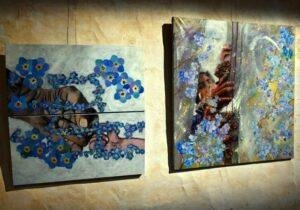
There are many and the hopeful messages he gives with indirect pictorial references, such as “souls” and butterflies, who transform, fly, free and lead to escape from the harsh everyday life, the emotional impasse, while empathizing with optimism to the next colored day away from the dark colorless present. For her work “The Dream”, she writes characteristically in her notes: “Child. Easy to be or unattainable? What happens when the entrance to the childhood path is not so carefree? When you are called upon to face difficulties, dead ends, doctors, sufferings, anxieties, insecurities. When being different is not always attractive and you have to fight to enshrine your status, yes, the childish! The girl’s lying down, sleeping? Her flocks rest near her. Her arsenal that supported her, helped her and made it difficult, severed her often but also caused comments and ridicule. He dreams, sails in a traveling world where everything is serene. Is it? It becomes a butterfly, beautiful, free, carefree but also ephemeral as ephemeral as the insouciance is.”
The Student also refers, undisguisedly but with sensitivity and special aesthetic emotion, to the controversial emotions born of social pressure to ensure “ideal marriage”. This long-awaited dream for centuries was at the same time a heavy social heritage in women and still often creates a kind of intangible coercion: “Life of flower grain. A male and a woman’s hand. The male touches timidly, hesitantly and tenderly the female leaving question marks… Will it tighten it? Will he protect it? Will he leave it? Will it keep it more dynamic? I don’t know! Uncertainty. Crowds of women still live waiting for the prince, while awaiting the perfect relationship. Why? Why? Life florist wish us at weddings, beautiful wish but can it be fulfilled? The flowers bleed and relationships are broken.”
In its iconography, the artist allows deformations, degrading and without limits fragmentations of anthropocentric realistic depictions. The dominant role is left to play the impulsively additional intense colors, the mischievously cast around the dominant performance. The reds of the blood, the black of darkness, the yellow of the flame scattered across the surface of the work catch the gaze and cause concern to the viewer.
Foitou with an unparalleled boldness makes reference to many issues of women, simple or insurmountable, who are often considered taboo, externalizes, communicates them, deposits them in her own way and turns the viewer into a communion of unspoken difficulties and a shareholder of a perpetual, silent struggle. She exploits, in a way, the beneficial effect of art on man and gives her own battle as a woman, in order to sensitize a wide audience and help the whole. She points out and underlines with aesthetic expression the size of the female psyche, and spreads her messages “from body to body.”
Louisa Karapidaki
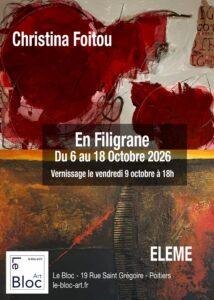
EN FILIGRANE – Duo exhibition: Eleme & Christina FOITOU – OCT 2026
Oct 06 2026 – Oct 18 2026 EXHIBITION ARCHIVE —...
Read More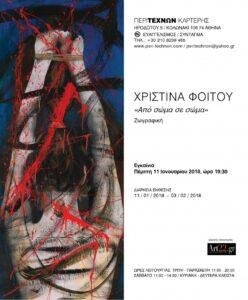
Text by curator Louisa Karapidaki on the exhibition entitled From body to body
Text by curator Louisa Karapidaki on the exhibition entitled From...
Read More
Interview with Anna Pachi of iart.gr on the occasion of the exhibition From body to body
PRESS & INTERVIEW — IART.GR ART IS A BALM Interview...
Read More