
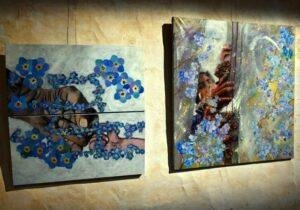
EXHIBITION ARCHIVE — SOLO SHOW FRAGMENTS ITINÉRANTS Christina Foitou DATES...
Read MoreInterview of Christina Fotou in Ira Paraskevi Papapostolou of Art22 on the occasion of her solo exhibition “From body to body” January 2018.
Trapped we are in the futility of our little existence, unable to really offer
Christina Foitou conveys to the canvas in her absolutely own way feelings and traumatic experiences. Her exhibition, with works of small and large dimensions, where figurative painting is combined with abstract and expressionistic elements, is dedicated to women.
Red, because women are bleeding, black for the darkness around us or what is inside our minds, green for the bright moments in our soul. Does she answer a few questions about her exposure “From Body to Body”?
 Wandering, mixed technique on canvas, 100 x 100 cm. 2017
You make works that express emotions, dreams, desires, hidden secrets. You talk to the viewer about loneliness, sadness, humiliation, fear and resistance to a brazen violence. Many of your works seem to depict martyrdom in hell. How painful can the course of the female soul and the very reality that a woman experiences be?
The anguish that every woman experiences sometimes internally and sometimes openly, does not translate so much as quantity, but more as quality, as intensity. It is a fine quality that accompanies sensations and emotions, which we carry as luggage, they mark us and characterize us. The woman, to this day, has not taken what she really deserves, nor has she found her place; she actually experiences situations from her childhood that carve her soul, perpetuating standards and expectations and determining her role and psyche.
As a woman, I have been asked to respond to what those around me expected from me as a daughter, woman, worker, wife, mother, squeaking very often my true ego, until at some point I dared to explode. And at this time of explosion I recommend it to all women, even if the spoiled around us are displeased. Of course, my answer to this question does not touch women who experience huge obvious sorrows in the Muslim world, in totalitarian regimes, in homes where domestic violence and their workplace reigns. And I don’t touch it because it goes without saying what we think.

Absence, mixed technique on canvas, 170 x 180 cm 2016 -2017
Your wives are usually gagged and in positions such (cooled, with their head bowed, with their backs turned to the viewer) that their body bears witness to signs of abuse. At the same time, you express in a very special way the concept of motherhood. What does it pay attention to the female body and on what occasion was the title of the exhibition “From body to body” was born?
The female body for me, beyond beautiful, is also sacred. Whatever shape it has, no matter how much weight, width, height it may have, whatever standards of the era it is called upon to serve, it ceases to seduce me. It is the beauty of its function and what it can inspire and give birth to which I cannot resist. I love it and I demand its absolute respect, I am emposed and hate its abuse and exploitation, its vulgarization. The title of the exhibition was born very spontaneously. Each work a female recounting, each work an emotional narrative, each body a story, from body to body unfolds the thread of what I want to shout through this unity.

The dream, mixed technique on canvas, 150 x 100 cm. 2017
I stood a long time in your work entitled “Absence”. A woman sitting in a multi-level space, a chair with a white cloth thrown on it and on the wall a photo of a beautiful family moment (where, in fact, you depict the family you have created). Who or who are, after all, absent in this setting?
In this work, while everyone is imagingly present, they are essentially praised as absentees. It is an ode to our lost dreams, to our lost relationships, to our lost places and to our lost childhood. This loss is symbolized by the empty, worn, spider-like space. The woman rests reminiscing for one last time, looking at the bright side of the room (point of hope), before giving up the life she lived there. A family photo of a happy moment is left there, in the worn frame, alive just enough to remind the beautiful moments that were experienced, while the dog has occupied his favorite place in the chair, waiting for it with the perimension of the faith that characterizes him. But she’ll believe in something new, now that all the old days are over, are they over? Now that everyone is essentially absent?

Endoscopy, mixed technique on canvas, 60 x 80 cm, 2016
What do colorful butterflies symbolize in your works? The joy of the soul? The freedom? The carefreeness?
And hope would add…
In the catalogue of the exhibition, in your notes on the work entitled “Dream” you read: “Child. Easy to be or unattainable? […] When being different is not always attractive and you have to fight to enshrine your status, yes, the childish! Do you think our diversity and child status are being attacked today, or does this continue to happen in different or worse ways? Tell me your own experience.
To think or believe that today – because of technological development, easy access to information, information, education, etc. – diversity and childishness, i.e., innocence, exist interserved, I consider it the least naive. Diversity “make jelly,” annoys, creates embarrassment, caution, morbid curiosity. We don’t let ourselves accept and love the different. We don’t let it surprise us or excite us. It is easier for us to have it outside of our lives, and at most we observe it from afar. How many of us sometimes break out on the different, confirming our strength and strength? No mercy, beyond the existence of individual exceptions, of people who support diversity and are passionately given to its service. Trapped we are in the futility of our small existence, looking at ourselves only, unable to really offer.
Our diversity and child status are being attacked over time, gradually growing up we lose our authenticity, we dry mentally and emotionally. My own experience has to do primarily with the experience of raising a child with a disability in a small town. Where curiosity replaces the source, sincere interest, but also where you have the opportunity to observe the human drama in its entirety because the numbers are not impersonal, where you perceive your size, what it means to fight and what it really deserves…
Hera Papapostolou
Historian and art critic
Art22
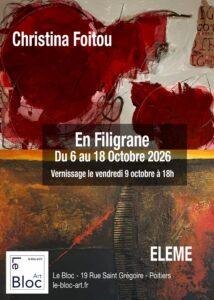
EN FILIGRANE – Exposition en duo : Eleme & Christina FOITOU – OCT 2026
Oct 06 2026 – Oct 18 2026 EXHIBITION ARCHIVE —...
Read More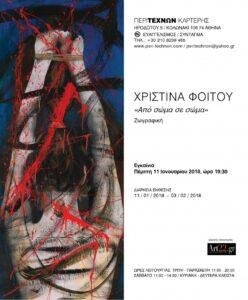
Texte de la curatrice Louisa Karapidaki sur l'exposition intitulée De corps à corps
Text by curator Louisa Karapidaki on the exhibition entitled From...
Read More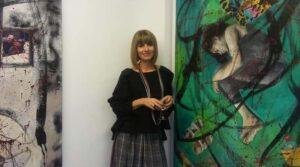
Entretien avec Anna Pachi d'iart.gr à l'occasion de l'exposition De corps en corps
PRESS & INTERVIEW — IART.GR ART IS A BALM Interview...
Read More